Instagram Aspect Ratio
A 1080 × 1920 Reel does not become a 1080 × 1350 feed frame for free. A centered 4:5 crop removes 285 pixels from the top and 285 from the bottom—570 pixels, or 29.6875% of the source height. A centered 3:4 crop removes 240 pixels from each end. This guide shows the arithmetic for every common handoff instead of repeating a size list.
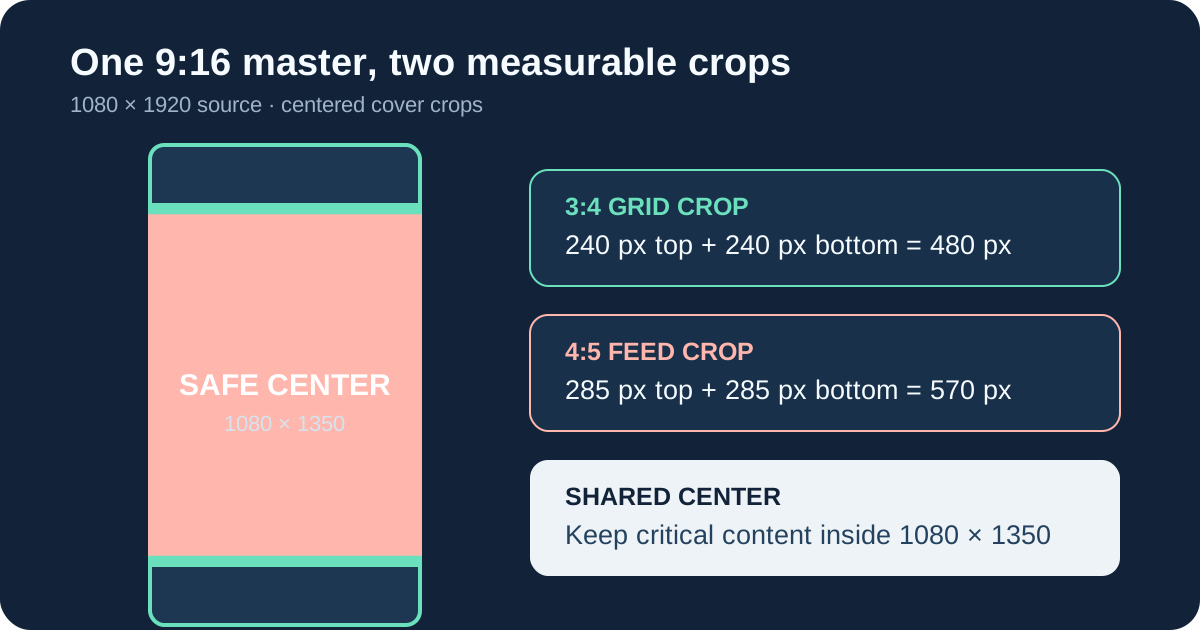
How much of a 9:16 Reel survives in feed and grid crops?
Start with the common vertical master: 1080 × 1920. Because the destination frames are wider relative to their height, keep the full 1080-pixel width and solve a shorter height.
| Destination | Retained frame | Centered crop | Source height removed |
|---|---|---|---|
| 4:5 feed | 1080 × 1350 | 285 top + 285 bottom | 29.6875% |
| 3:4 profile grid | 1080 × 1440 | 240 top + 240 bottom | 25% |
| 1:1 square | 1080 × 1080 | 420 top + 420 bottom | 43.75% |
The 4:5 height is 1080 × 5 ÷ 4 = 1350. Subtract that from 1920 to get 570 cropped pixels, then divide by two for a centered crop. The 3:4 and square rows use the same steps.
9:16 → 4:5 proof
Target height = 1080 × 5 ÷ 4 = 1350
Total crop = 1920 − 1350 = 570
Each edge = 570 ÷ 2 = 285
Anything outside y = 285 through y = 1634 in the original frame is not inside the centered 4:5 result.
The 3:4 versus 4:5 trade is small, but it is not zero
A 3:4 post at 1080 × 1440 is 90 pixels taller than a 4:5 post at 1080 × 1350. Converting it to 4:5 at the same width removes 45 pixels from the top and 45 from the bottom. That is 6.25% of the 3:4 source height.
The reverse conversion uses a cover crop because a 4:5 source is wider relative to its height. Scale 1080 × 1350 to 1152 × 1440, then crop the width from 1152 to 1080. The centered output removes 36 scaled pixels from each side, 72 total. In coordinates on the original 1080-pixel source, that boundary is 33.75 pixels per side.
This is the practical reason a title placed against the edge of a 4:5 design can be clipped in a 3:4 preview even though the two frames look similar. Keep critical content inside the central 93.75% of the source width when one design must cover both.
Crop ledger for one-file reuse
The table below assumes a centered “cover” conversion: fill the destination completely, preserve geometry, and discard the overflow. It does not assume stretching.
| Source | Destination canvas | Scaled source before crop | Pixels removed |
|---|---|---|---|
| 1080 × 1920 (9:16) | 1080 × 1350 (4:5) | 1080 × 1920 | 285 top + 285 bottom |
| 1080 × 1920 (9:16) | 1080 × 1440 (3:4) | 1080 × 1920 | 240 top + 240 bottom |
| 1080 × 1920 (9:16) | 1080 × 1080 (1:1) | 1080 × 1920 | 420 top + 420 bottom |
| 1080 × 1440 (3:4) | 1080 × 1350 (4:5) | 1080 × 1440 | 45 top + 45 bottom |
| 1080 × 1350 (4:5) | 1080 × 1440 (3:4) | 1152 × 1440 | 36 left + 36 right |
| 1080 × 1080 (1:1) | 1080 × 1440 (3:4) | 1440 × 1440 | 180 left + 180 right |
| 1080 × 1080 (1:1) | 1080 × 1350 (4:5) | 1350 × 1350 | 135 left + 135 right |
| 1080 × 1350 (4:5) | 1080 × 1920 (9:16) | 1536 × 1920 | 228 left + 228 right |
These crop amounts describe the chosen conversion, not a promise that every Instagram surface will always render the same preview. Interfaces change, and a user can reposition some crops. The arithmetic tells you what a centered cover crop must discard when the two frame ratios are fixed.
Use padding when every edge must survive
Padding solves the opposite problem. It preserves the whole source, but the destination contains empty space that must be filled with a color, blur, graphic extension, or other background.
Keep a 4:5 post complete in a 9:16 Story
Place 1080 × 1350 content on a 1080 × 1920 canvas. The vertical gap is 1920 − 1350 = 570 pixels, so a centered layout adds 285 pixels above and 285 below. Notice that these are the same numbers as the reverse 9:16-to-4:5 crop.
Keep a square post complete in a 3:4 grid canvas
Place 1080 × 1080 content on a 1080 × 1440 canvas. The gap is 360 pixels, so add 180 pixels above and 180 below. Filling the canvas instead would scale the square to 1440 × 1440 and crop 180 pixels from each side.
Use the site’s image aspect ratio calculator to solve a missing side for a custom source. Then use the crop formula below to decide what survives.
The crop formula works for any Instagram source size
Let the source be W × H and the destination ratio be A:B. Compare W ÷ H with A ÷ B.
- 1Source is too tall
Keep width W. Retained height = W × B ÷ A. Crop per vertical edge = (H − retained height) ÷ 2.
- 2Source is too wide
Keep height H. Retained width = H × A ÷ B. Crop per horizontal edge = (W − retained width) ÷ 2.
- 3Find the loss rate
Loss % = (source area − retained area) ÷ source area × 100. With one axis unchanged, the same result comes from the cropped-axis lengths.
Fractional boundaries are normal during resampling. If a final crop tool requires whole pixels, compare the two neighboring integers and choose the one whose output ratio is closer, or scale first to dimensions where the boundary becomes whole.
Instagram aspect ratio crop questions
How much is cropped from a 9:16 Reel in a 4:5 feed preview?
At 1080 × 1920, a centered 4:5 crop keeps 1080 × 1350 and removes 285 pixels from the top plus 285 from the bottom. The removed height is 29.6875% of the source.
How much is cropped when 4:5 becomes 3:4?
After scaling 1080 × 1350 to 1152 × 1440, a centered 3:4 output removes 36 pixels from each side. That is 6.25% of the scaled width in total.
Can one 1080 × 1920 design cover Reels, feed, and profile grid?
Yes, if all critical content fits inside the smallest shared centered region: 1080 × 1350. The feed crop removes 285 pixels from both vertical ends, while the 3:4 crop removes 240 from both ends.
Should I crop or pad an Instagram asset?
Crop when the destination must be filled edge to edge. Pad when every source edge must remain visible. Stretching is neither: it changes the geometry and should be avoided.
Sources and calculation scope
Instagram’s current supported photo range and 1080-pixel width behavior were checked against the Instagram Help Center. The placement descriptions for square, vertical, Story, Reel, feed, and grid views were cross-checked against Adobe Express. API-oriented accepted ranges and 3:4 feed-display notes were checked against Buffer Help.
Every crop, padding, percentage, and boundary on this page was recalculated from the printed source and destination dimensions. The conversion ledger is original arithmetic for this guide; the cited sources establish platform dimensions and placement context, not the calculated crop totals.