Image Mat and Border Aspect Ratio Calculator
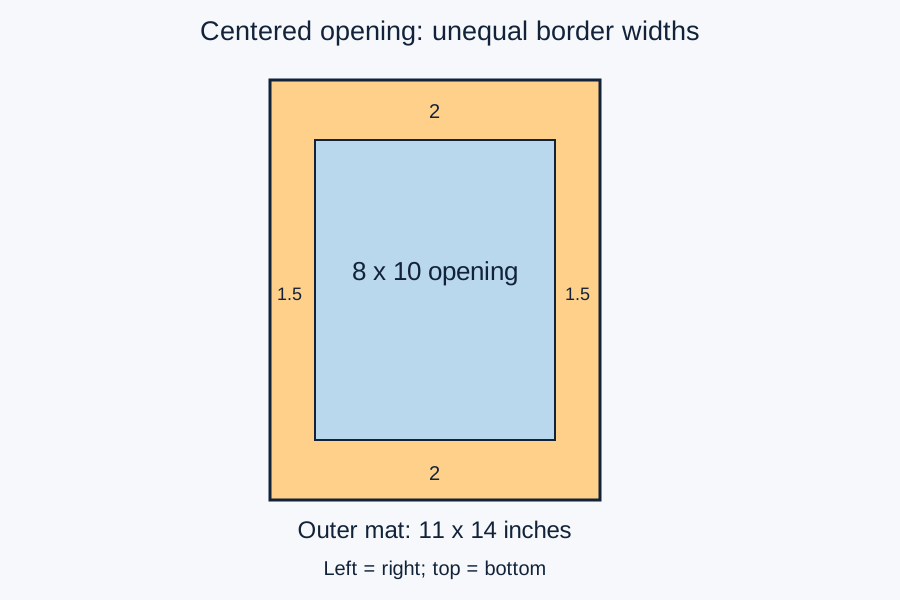
Subtract opening width from outer width and divide by two for each side. Repeat with heights for the top and bottom. An 8 x 10 opening in an 11 x 14 mat has 1.5-inch side borders and 2-inch vertical borders.
Calculate the border on each axis
Let W and H be the artwork opening, and Fw and Fh the outer mat dimensions. Keep every measurement in the same unit. The centered left and right borders are bx=(Fw-W)/2; the top and bottom borders are by=(Fh-H)/2. Both must be nonnegative. Symmetry means opposite sides match; it does not mean bx equals by.
For an 8 by 10 opening in an 11 by 14 mat, bx=(11-8)/2=1.5 inches and by=(14-10)/2=2 inches. Check by reconstruction: 8+2(1.5)=11 and 10+2(2)=14. The outer ratio is 11/14, while the opening ratio is 8/10. Different ratios are possible without cropping because the surrounding mat absorbs the difference.
When can all four borders be equal?
A fixed opening and fixed mat allow one equal border b only if Fw-W=Fh-H=2b. The 8 by 10 opening and 11 by 14 mat fail this test: the differences are 3 and 4. Calling both borders 1.5 would produce an 11 by 13 mat, one inch shorter than requested.
If only the desired outer ratio R is fixed, solve (W+2b)/(H+2b)=R. Rearrangement gives b=(W-RH)/(2(R-1)). For an 8 by 10 opening and a 4:5 outer ratio, b=0: the artwork already has that ratio, and any positive equal border moves the outer ratio toward a square. For a 3:4 target, b=(8-0.75(10))/(2(0.75-1))=-1. A negative border cannot be added; that target needs cropping, unequal borders, or a different opening.
For a 5:6 target, b=(8-(5/6)(10))/(2(5/6-1))=1. The outer mat becomes 10 by 12, and 10/12=5/6. This supplies a feasible positive counterexample. If R=1, division is undefined: equal borders can make a square only when W=H already. A rectangular opening approaches a square as borders grow, but never becomes exactly square with finite equal borders.
Four independently checked examples
| Opening | Outer mat | Left / right | Top / bottom | Equal on all sides? |
|---|---|---|---|---|
| 8 x 10 | 11 x 14 | 1.5 | 2 | No |
| 8 x 10 | 12 x 14 | 2 | 2 | Yes |
| 6 x 4 | 10 x 8 | 2 | 2 | Yes |
| 12 x 8 | 10 x 10 | -1 | 1 | Does not fit |
The last row is intentionally invalid. A negative side border says the opening exceeds the available width by 2 units. Do not silently convert that negative value into a positive border. At unchanged artwork size this combination cannot work.
For the first row, the opening area is 80 square inches and the outer area is 154. The visible mat area is 154-80=74 square inches, or 74/154 x 100=48.052% of the outer rectangle. This percentage measures mat coverage, not image loss: the specified opening is preserved in full.
Resizing an image is a separate decision
Suppose a 12 by 8 image must fit inside a 10 by 10 digital canvas. At fixed size, our border test rejects it. If resizing is allowed, use s=min(10/12,10/8)=5/6. The fitted image becomes 10 by 6.666667, leaving zero side padding and 1.666667 above and below. That is a contain calculation; it changes the image size and does not guarantee any positive border on every side.
To reserve a minimum 1-unit border, first reduce the available box to (10-2) by (10-2)=8 by 8. Then s=min(8/12,8/8)=2/3, giving an 8 by 5.333333 image. The final side borders are 1 and the final vertical borders are (10-5.333333)/2=2.333333. Reserving one unit is a minimum, not a promise of four equal borders.
In raster output, retain fractional geometry until export. Rounding a 6.666667 height to 7 on a 10-unit canvas leaves 3 units, so centered integer padding must split as 1 and 2. The one-pixel asymmetry is an export constraint, not a change to the continuous formula.
Avoid measurement errors
Use the desired visible opening, rather than automatically using the complete paper size. A physical mat may overlap the print edge to hold it. Specify that overlap separately; this tool does not prescribe a mounting allowance or a cutting tolerance.
Use the outer matboard size that fits inside the frame, not the external moulding measurement. Mixing inches and centimeters invalidates subtraction. Rotate the dimensions explicitly if the artwork is turned. A bottom-weighted mat intentionally changes the top and bottom split and is outside this centered calculation.
Sources checked on 2026-11-15
The linked references distinguish mat openings and outer dimensions, and describe proportional image fitting. The equations, cases, failure analysis and diagram above were produced independently.
For resizing instead of fixed opening dimensions, use the letterbox calculator.