Batch Aspect Ratio Size Generator
Under 1920 × 1080, a 16:9 batch with a 20-multiplier stride starts at 1920 × 1080, then 1600 × 900, 1280 × 720, 960 × 540, 640 × 360 and 320 × 180. Every pair is exact and even.
| # | Multiplier | Width | Height | Pixels | Cross-product error |
|---|
One reduced ratio, six audited outputs
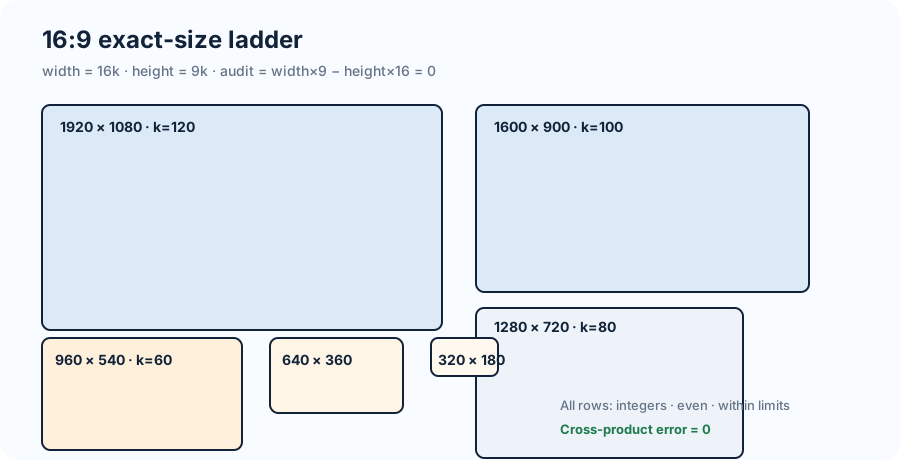
The diagram is generated from one integer ladder, not six rounded decimal calculations. Each width is 16 × k and each height is 9 × k. The default multipliers are 120, 100, 80, 60, 40 and 20, so the dimensions remain exact while the pixel area falls from 2,073,600 to 57,600.
The batch formula
Reduce the requested ratio A:B by its greatest common divisor to obtain a:b. Every exact integer size has the form (a × k) × (b × k) for a positive integer multiplier k. With maximum width Wmax and maximum height Hmax, the largest legal multiplier is:
kmax = min(floor(Wmax ÷ a), floor(Hmax ÷ b))row i: width = a × (kmax − iS), height = b × (kmax − iS)
For 16:9 inside 1920 × 1080, both bounds give 120, so kmax = 120. A stride S = 20 produces the six default rows. Exactness is checked with integer cross-products: width × b − height × a. Every row returns zero; a nonzero value would expose rounding drift.
When even dimensions are required, the multiplier must make both a × k and b × k even. For reduced 16:9, the odd height term forces k to be even. The generator lowers an incompatible start to the nearest valid multiplier and raises the requested stride to the next compatible multiple.
Four controlled limit tests
| Ratio and limits | Even? | Largest exact result | Binding limit | Rejected rounded shortcut |
|---|---|---|---|---|
| 16:9 · 1920 × 1080 | Yes | 1920 × 1080 | Both | None needed |
| 16:9 · 1500 × 1000 | Yes | 1472 × 828 | Width | 1500 × 844 drifts |
| 4:3 · 1000 × 700 | No | 932 × 699 | Height | 933 × 700 drifts |
| 21:9 · 2560 × 1080 | Yes | 2520 × 1080 | Height | 2560 × 1097 exceeds height |
The 1500-pixel 16:9 case reduces to multiplier 93, but even height requires an even multiplier, so the valid start is 92: 16 × 92 = 1472 and 9 × 92 = 828. The tempting rounded pair 1500 × 844 fails the proof because 1500 × 9 − 844 × 16 = −4.
The 4:3 test is height-limited: floor(700 ÷ 3) = 233, giving 932 × 699. The 21:9 label reduces to 7:3; with even output enabled, multiplier 360 yields 2520 × 1080. Using the full 2560 width would require more than the allowed height, so the width limit is not always the active one.
Why batch generation catches pipeline mistakes
Calculating every row independently from a decimal such as 1.7778 can create a mixed list: some rows land exactly on 16:9, while others differ by one pixel. An integer multiplier keeps the relationship auditable across the whole batch. It also makes duplicates impossible when the stride is positive.
A second failure is checking only one maximum. A width-derived size can exceed the height cap, and a height-derived size can exceed the width cap. Taking the minimum of the two multiplier bounds is the step that enforces both limits simultaneously.
A third failure is treating “even” as a final cosmetic rounding pass. Rounding an exact odd dimension upward or downward changes the ratio. This generator instead chooses multipliers that produce even dimensions before it computes the rows, preserving a cross-product error of zero.
Batch size questions
Are all generated sizes exact?
Yes. Each pair is built from the same reduced-ratio multiplier, then verified by cross multiplication. The tool does not round a decimal height.
Why is the largest width sometimes below my maximum?
The height limit may bind first, or an even-dimension rule may require a lower compatible multiplier. A maximum is a ceiling, not a target that must be filled.
What does multiplier stride control?
It controls the distance between adjacent exact sizes. A larger stride produces a more widely spaced batch without changing the ratio.
Can a batch stop before reaching the requested count?
Yes. Generation stops when the next multiplier would be zero or negative, because zero-sized and negative-sized frames are invalid.
Method and sources
The generator treats an aspect ratio as width divided by height, reduces it to integer terms, and enumerates positive integer multiples under both limits. The current technical references checked on 2026-11-03 were MDN's ratio data type, MDN's aspect-ratio property, FFmpeg's video-size notation, and FFmpeg's scaling filter documentation. All generated tables, limit tests, cross-products and error findings on this page were calculated specifically for this page.