4:3 Aspect Ratio
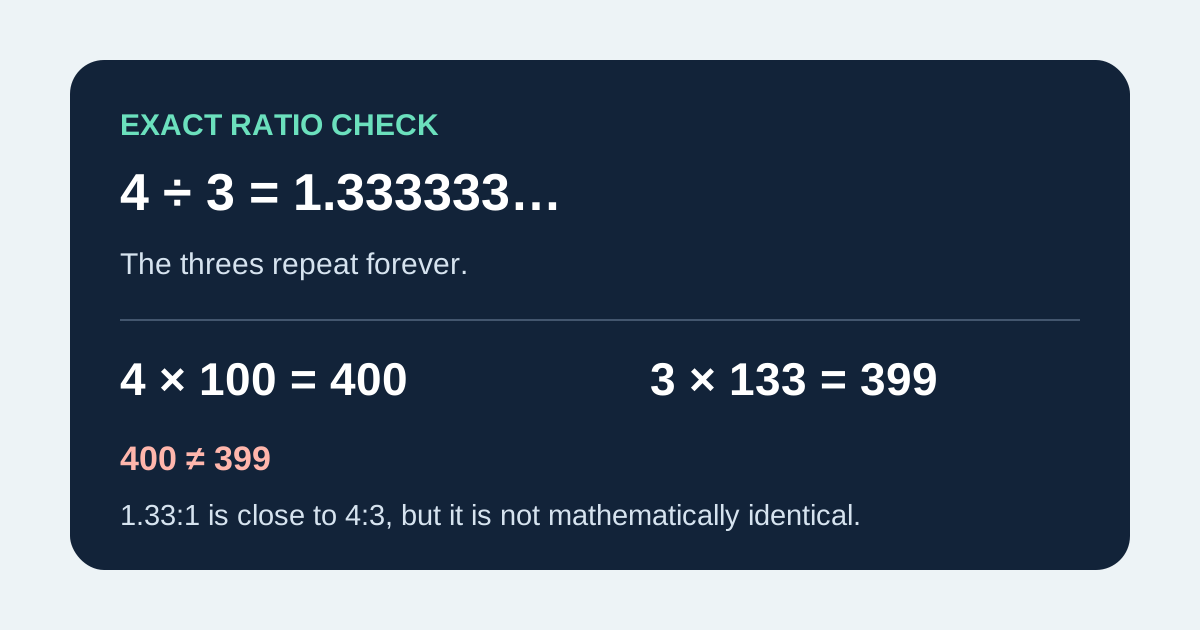
4:3 does not equal the finite label 1.33:1. Exact 4:3 is 1.333333…:1, and an integer pixel grid is exact only when width × 3 = height × 4. Common exact sizes include 640 × 480, 800 × 600, 1024 × 768, and 1600 × 1200.
Is 4:3 exactly 1.33:1?
No. The fraction 4:3 produces a repeating decimal, while 1.33:1 stops after two decimal places. Written as whole-number fractions, the comparison is 4:3 versus 133:100.
Cross multiplication gives 4 × 100 = 400 and 3 × 133 = 399. The unequal products prove that the ratios are different without rounding either value. Relative to exact 4:3, finite 1.33:1 is lower by 0.25%.
Verify a claimed 4:3 size in three steps
- 1Keep the source pixels
Record the uncropped width and height before any player or editor rescales them.
- 2Make two products
Calculate width × 3 and height × 4 with integers.
- 3Compare exactly
Matching products certify 4:3; a one-unit mismatch is still a different ratio.
1365 × 1024
1365 × 3 = 4,095
1024 × 4 = 4,096
The products differ by one, so 1365 × 1024 is near 4:3 rather than exact.
Exact sizes follow one integer rule
For whole-pixel dimensions, every exact 4:3 frame can be written as 4n × 3n, where n is a positive whole number. This means an exact width is divisible by 4 and its matching height is divisible by 3.
A height of 1080 therefore pairs with width 1080 × 4 ÷ 3 = 1440. A width of 2000 pairs with height 2000 × 3 ÷ 4 = 1500. A width of 1001 would require 750.75 pixels, so no integer height can make that fixed width exactly 4:3.
Measure nearby grids instead of trusting the label
The relative-error calculation is |W ÷ H − 4 ÷ 3| ÷ (4 ÷ 3) × 100. The cross-product columns expose the same distinction without decimal rounding.
| Pixels | Reduced ratio | Cross-products | Relative error |
|---|---|---|---|
| 1365 × 1024 | 1365:1024 | 4095 vs 4096 | 0.024414% |
| 1366 × 1024 | 683:512 | 4098 vs 4096 | 0.048828% |
| 1367 × 1024 | 1367:1024 | 4101 vs 4096 | 0.122070% |
| 1920 × 1440 | 4:3 | 5760 vs 5760 | 0% — exact |
At a fixed height of 1024, the 1365-pixel width is mathematically closer to 4:3 than either 1366 or 1367. That result does not make 1365 × 1024 exact; it only identifies the smallest error among the three tested grids.
Choose whole-pixel rounding by measuring both options
Suppose the fixed width is 1001 pixels. The ideal 4:3 height is 1001 × 3 ÷ 4 = 750.75 pixels, which cannot be stored as an integer pixel row.
Rounding down produces 1001 × 750. Its cross-products are 3003 and 3000, and its relative error is 0.100000%.
Rounding up produces 1001 × 751. Its cross-products are 3003 and 3004, and its relative error is 0.033289%.
For this input, 751 is the lower-error integer height. If exact 4:3 is mandatory, change the width to 1000 and use 1000 × 750 instead of rounding.
Fit a 4000 × 3000 photo into a 1920 × 1080 frame
The source is exact 4:3 because 4000 × 3 and 3000 × 4 both equal 12,000. The destination is 16:9, so preserving every source pixel and filling the destination are separate goals.
To preserve the complete photo, scale it to 1440 × 1080. The remaining width is 1920 − 1440 = 480 pixels, which creates two side bars of 240 pixels each.
To fill the destination, keep the 4000-pixel source width and crop its height to 4000 × 9 ÷ 16 = 2250. The crop removes 3000 − 2250 = 750 pixels in total, or 375 pixels from both the top and bottom when centered.
Stretching 4000 × 3000 directly to 1920 × 1080 changes the geometry, so it is not a crop or padding solution.
One 3:2 conversion ledger
Start with the exact 4:3 frame 2400 × 1800. A same-width 3:2 crop is 2400 × 1600, removing 200 pixels total or 100 from each horizontal edge.
A same-height 3:2 canvas is 2700 × 1800. It adds 300 pixels total or 150 on each vertical side while preserving the original 2400 × 1800 image.
Use the 4:3 aspect ratio calculator when you only need a missing side; use the ledgers above when the decision also involves crop or padding.
4:3 aspect ratio questions
Does the finite decimal 1.33:1 equal the fraction 4:3?
No when the numbers are interpreted literally. Exact 4:3 repeats as 1.333333…:1, whereas finite 1.33:1 is 133:100 and is 0.25% lower relative to 4:3.
Which integer sizes are guaranteed to be exact 4:3?
Use 4n × 3n with one positive whole number n. For n = 375, the result is 1500 × 1125, and both cross-products equal 4500.
What should I do when the calculated side is fractional?
Test the integers immediately below and above the fractional result, then compare their cross-product residuals or relative errors. For width 1001, height 751 is closer than 750, but neither choice is exact.
Should a 4:3 image be cropped or padded for 16:9?
Pad when every source edge must remain visible, and crop when the destination must be filled. For the 4000 × 3000 example above, preservation produces 240-pixel side bars after scaling, while filling removes 375 source pixels from both the top and bottom.
Sources and calculation scope
The historical description and established display sizes were checked against the Wikipedia fullscreen overview. Display fitting terms were checked against TRU-Vu’s 4:3 and 16:9 comparison. Film-label context was checked against PremiumBeat’s 4:3 history.
Every cross-product, reduced ratio, error percentage, crop amount, and padding amount on this page was calculated from the pixel dimensions printed beside it. No competitor sentence or example order was copied into this guide.