16:9 Aspect Ratio Calculator
For a 16:9 frame, calculate height = width × 9 ÷ 16 or width = height × 16 ÷ 9. A 1280 px width gives exactly 720 px; a 720 px height gives exactly 1280 px.
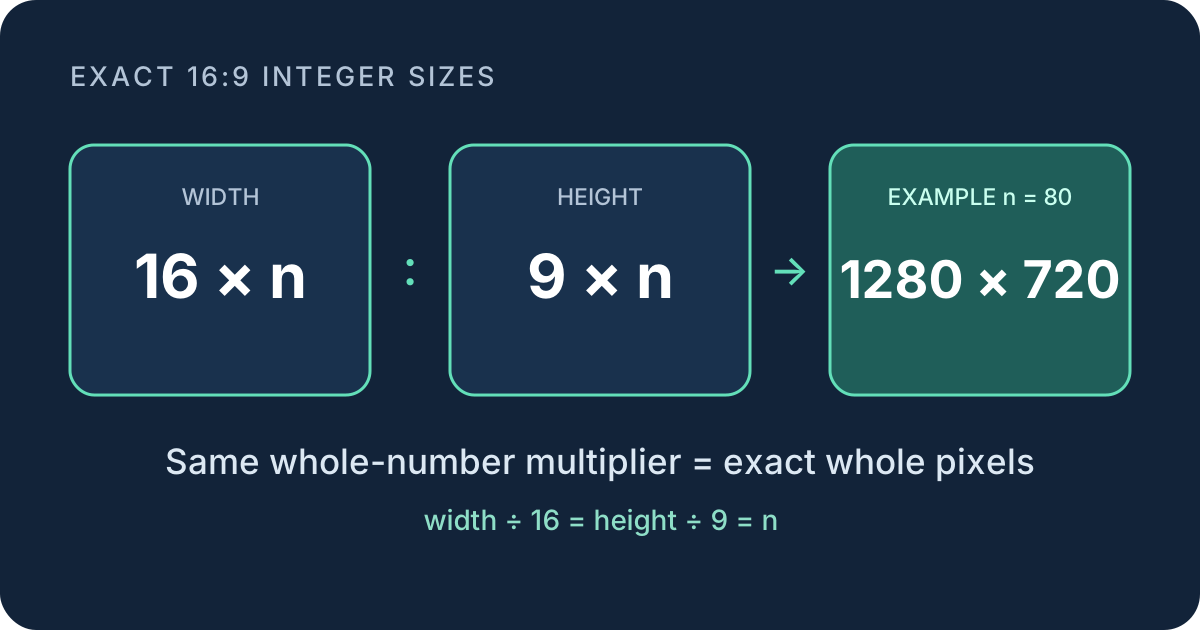
Exact 16:9 sizes are one integer sequence
Write every exact whole-pixel pair as 16n × 9n, where n is a positive whole number. This produces both dimensions without rounding. For example, n = 80 gives 16 × 80 = 1280 and 9 × 80 = 720. The same test works in reverse: divide a proposed width by 16 and its height by 9. If both quotients are the same whole number, the pair is exactly 16:9.
| n | Width | Height | Check |
|---|---|---|---|
| 20 | 320 | 180 | 320 ÷ 16 = 180 ÷ 9 = 20 |
| 40 | 640 | 360 | 640 ÷ 16 = 360 ÷ 9 = 40 |
| 60 | 960 | 540 | 960 ÷ 16 = 540 ÷ 9 = 60 |
| 80 | 1280 | 720 | 1280 ÷ 16 = 720 ÷ 9 = 80 |
| 100 | 1600 | 900 | 1600 ÷ 16 = 900 ÷ 9 = 100 |
| 120 | 1920 | 1080 | 1920 ÷ 16 = 1080 ÷ 9 = 120 |
| 160 | 2560 | 1440 | 2560 ÷ 16 = 1440 ÷ 9 = 160 |
| 240 | 3840 | 2160 | 3840 ÷ 16 = 2160 ÷ 9 = 240 |
Calculate from either known side
Known width
Height = width × 9 ÷ 16
Known height
Width = height × 16 ÷ 9
Keep the unrounded result long enough to see whether it is an integer. With a width of 1366, the exact height is 1366 × 9 ÷ 16 = 768.375. With a height of 768, the exact width is 768 × 16 ÷ 9 = 1365⅓. Neither calculation gives the integer pair 1366 × 768 as exact 16:9.
Audit a rounded 16:9 result
A raster dimension must be a whole pixel, but rounding changes the ratio. Start with a width of 1000. Its exact 16:9 height is 562.5. Rounding down produces 1000 × 562; rounding up produces 1000 × 563. The target decimal ratio is 16 ÷ 9 = 1.777777…. The two integer results are 1000 ÷ 562 ≈ 1.77936 and 1000 ÷ 563 ≈ 1.77620.
You can express the error as a missing-width comparison at the chosen height. At 562 px high, an exact 16:9 width would be 562 × 16 ÷ 9 ≈ 999.11, so 1000 px is about 0.89 px wider. At 563 px high, an exact width would be about 1000.89, so 1000 px is about 0.89 px narrower. This identifies the direction of the distortion instead of calling both pairs exact.
- Calculate the missing side without rounding.
- If it is an integer, label the pair exact.
- If it is fractional, record the rounding rule.
- Divide the final width by final height and compare it with 16 ÷ 9.
Find the nearest exact size without guessing
For a proposed width, divide by 16 to find n. If n is fractional, use the neighboring whole numbers to generate the nearest exact widths. A width of 1000 gives n = 62.5, so the neighboring exact pairs use n = 62 and n = 63: 992 × 558 and 1008 × 567. Each candidate is 8 pixels away in width, while both preserve exact 16:9 geometry.
For a proposed height, divide by 9. A height of 1000 gives n = 111.111…, so the neighboring exact heights are 999 and 1008. Their complete pairs are 1776 × 999 and 1792 × 1008. Choose between the neighbors according to the allowed canvas limit, then resize or crop once rather than accumulating several rounded transformations.
16:9 calculation questions
Is 1366 × 768 exactly 16:9?
No. Cross multiplication gives 1366 × 9 = 12,294 and 768 × 16 = 12,288. Because the products differ, the pair is only close to 16:9.
Which widths always give a whole 16:9 height?
Widths divisible by 16. After dividing the width by 16, multiply that whole-number result by 9.
Can I keep a non-divisible width?
Yes, but the calculated height will require rounding for a raster image. Record the rounding rule and verify the final width-to-height ratio.