16:10 Aspect Ratio
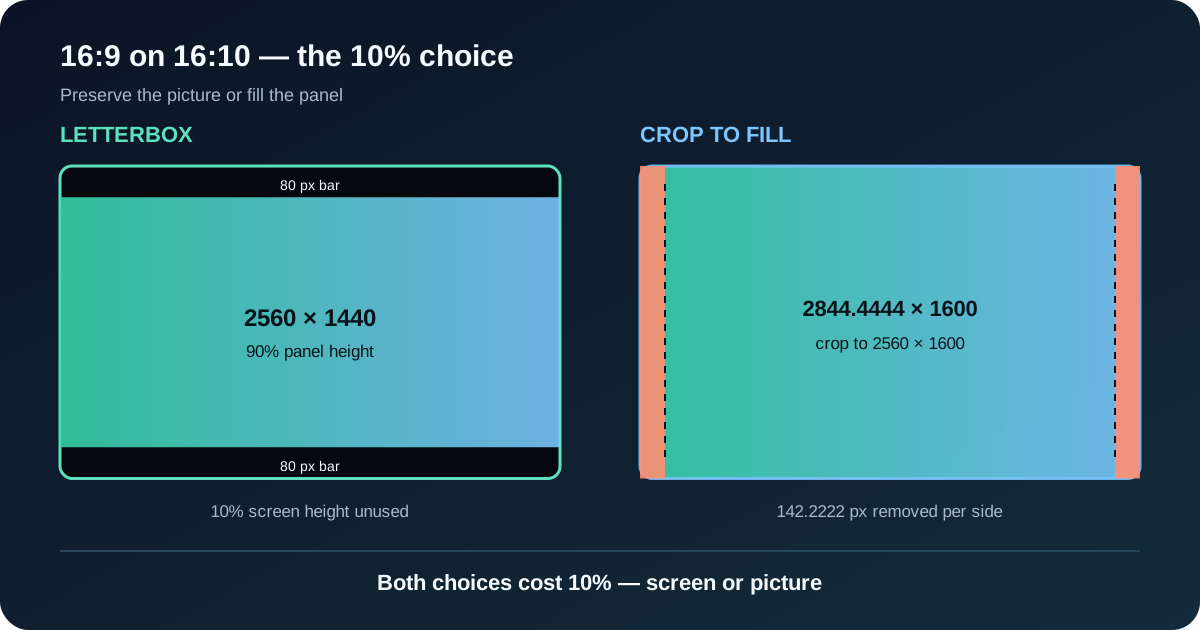
16:10 reduces to 8:5, or 1.6:1. At the same 2560-pixel width, 16:10 is 2560 × 1600 while 16:9 is 2560 × 1440, so the 16:10 frame has 160 extra vertical pixels. A 16:9 image can keep every pixel with 80-pixel bars above and below, or fill the screen after a 10% horizontal crop.
Exact 16:10 sizes use the same 8:5 scale factor
Because 16:10 reduces to 8:5, write every exact whole-pixel pair as W = 8k and H = 5k. The cross-product test is 5W = 8H. Dividing both dimensions by their ratio terms must also return one shared whole number: W / 8 = H / 5 = k.
1920 × 1080 and 1280 × 720 are 16:9, not 16:10. Their decimal ratio is 1.777777…, while exact 16:10 is 1.6.
How much taller is 16:10 than 16:9 at the same width?
Hold width at 2560 pixels. A 16:9 height is 2560 × 9 / 16 = 1440. A 16:10 height is 2560 × 10 / 16 = 1600. The difference is 1600 - 1440 = 160 pixels.
Measured against the 16:9 height, the increase is 160 / 1440 × 100 = 11.1111%. This percentage describes the extra height relative to the original 16:9 picture; it is different from the 10% share of the final 16:10 panel that remains unused when the picture is letterboxed.
Should I letterbox or crop 16:9 on a 16:10 screen?
Keep the full picture: letterbox
Fit 2560 × 1440 content by width on the 2560 × 1600 panel. The unused height is 160 pixels, split into 80 pixels above and 80 below.
Each bar uses 80 / 1600 = 5% of panel height. Together the bars use 10%, while the picture occupies 1440 / 1600 = 90% of panel height.
Fill the screen: crop
Scale the 16:9 picture to the panel height. Its scaled width becomes 1600 × 16 / 9 = 2844.4444 pixels.
The excess width is 2844.4444 - 2560 = 284.4444 pixels, so a centered crop removes 142.2222 pixels from each side. The removed share is 284.4444 / 2844.4444 = 10% of the scaled picture width.
Both choices cost 10%: letterboxing gives up 10% of the screen height; cropping gives up 10% of the scaled picture width. Keep every edge with letterboxing. Choose cropping when a full screen matters more than preserving the complete picture.
Convert a known side to exact 16:10
- 1Reduce the ratio
Use 8:5, the simplest form of 16:10.
- 2Calculate the missing side
Known width: H = W × 5 / 8. Known height: W = H × 8 / 5.
- 3Verify the stored pixels
Confirm 5W = 8H and check that W / 8 equals H / 5 as one whole-number k.
Use the aspect ratio calculator when one side is missing. Keep the calculated value unrounded until you know whether a whole-pixel result exists.
16:10 aspect ratio questions
Is 16:10 the same as 8:5?
Yes. Dividing both terms of 16:10 by 2 gives 8:5. Both equal a width-to-height ratio of 1.6:1.
Is 1920 × 1080 a 16:10 resolution?
No. It is 16:9. At a width of 1920 pixels, exact 16:10 height is 1920 × 5 / 8 = 1200 pixels.
How do I test whether dimensions are exactly 16:10?
Check whether 5 times the width equals 8 times the height. For an integer-grid proof, width divided by 8 and height divided by 5 must return the same whole number.
Should I crop or use black bars for 16:9 content on a 16:10 screen?
Use bars when the complete picture must remain visible. Crop when filling the entire screen matters more. On a 2560 × 1600 panel, the measured tradeoff is 10% of panel height for bars or 10% of the scaled picture width for crop.
Sources
The ratio reduction, integer grid, cross-products, same-width comparison, bar sizes, crop sizes, and percentages on this page were derived from the dimensions printed beside them and independently recalculated before publication. The fit and fill choices correspond to the contain and cover behavior documented by MDN. The site’s aspect ratio calculator reproduces the missing-side calculations.