Even Dimension Aspect Ratio Checker
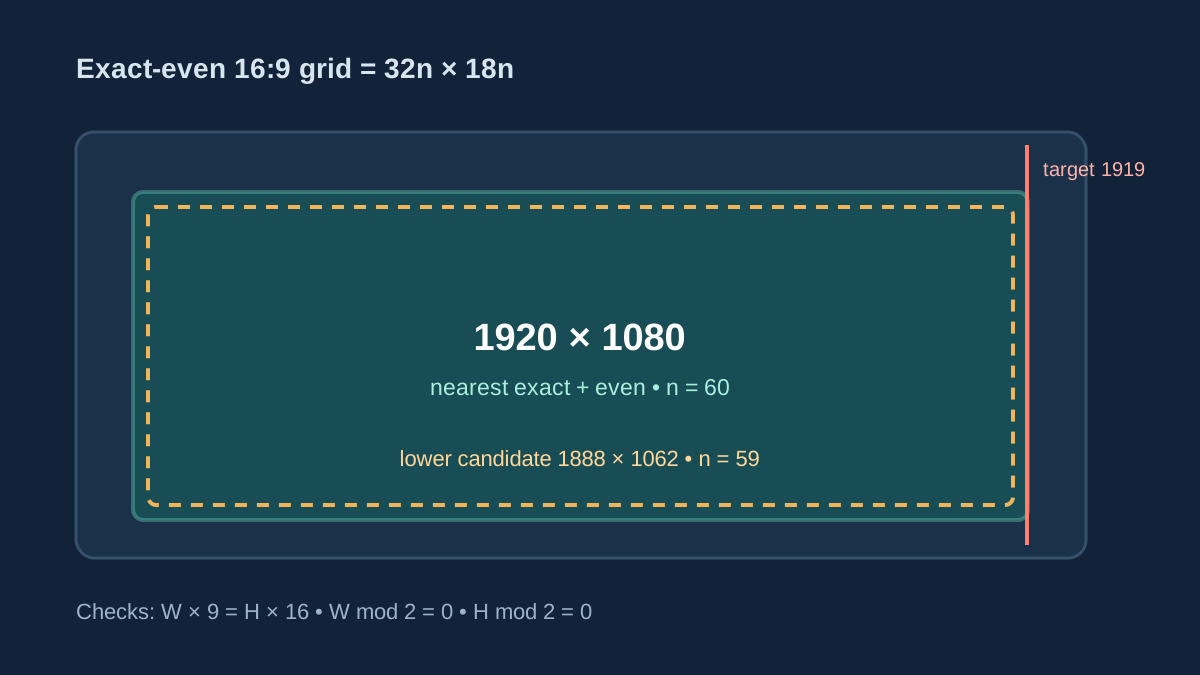
For 16:9 near 1919 pixels wide, the nearest exact even size is 1920 × 1080. The exact-even grid advances by 32 × 18, so the next lower pair is 1888 × 1062. Both pass evenness and cross-product checks.
Direct answer: use 32n × 18n1920 × 1080
Audit the 1919-pixel calculation
Reduce 16:9 first. The greatest common divisor is 1, so every exact integer pair is 16k × 9k. Width is already even for every k, but height is even only when k is even. Therefore write k = 2n. Every exact pair whose two dimensions are even is 32n × 18n.
The nearest integer n is 60, producing 32 × 60 = 1920 and 18 × 60 = 1080. The width difference is +1 pixel. Cross multiplication proves exactness: 1920 × 9 = 17,280 and 1080 × 16 = 17,280. Both dimensions have a remainder of zero when divided by two.
The lower candidate uses n = 59: 1888 × 1062. It is 31 pixels below the target width and also passes both checks. Comparing absolute differences, 1 is smaller than 31, so 1920 × 1080 is the nearest exact-even pair. If the output must not exceed 1919 pixels, choose the lower candidate instead.
The exact-even formula
Reduce A:B by g=gcd(A,B) to a=A/g and b=B/g.
Because a reduced pair cannot have two even terms, both dimensions become even at every step 2a × 2b.
For target width T, use n=max(1, round(T/(2a))).
Return W=2an, H=2bn; verify Wb=Ha, W mod 2=0, and H mod 2=0.
The factor of two is not an approximation. It selects a subset of the exact ratio grid. For 4:3, the primitive step is 4 × 3 and the exact-even step is 8 × 6. A 1000-pixel target lands exactly on n = 125, giving 1000 × 750.
By contrast, keeping an arbitrary even width and merely rounding the calculated height to an even number can introduce drift. At width 1366, the ideal 16:9 height is 768.375. Choosing 768 gives an even pair, but 1366 × 9 = 12,294 while 768 × 16 = 12,288. The cross-product difference is 6, so the pair is close but not exact.
Exact-even tests and drift controls
| Ratio | Target width | Nearest exact-even | Lower exact-even | Audit |
|---|---|---|---|---|
| 16:9 | 1919 | 1920 × 1080 | 1888 × 1062 | +1 px |
| 16:9 | 1366 | 1376 × 774 | 1344 × 756 | +10 px |
| 4:3 | 1000 | 1000 × 750 | 1000 × 750 | exact hit |
| 3:2 | 799 | 798 × 532 | 798 × 532 | -1 px |
| 21:9 → 7:3 | 3440 | 3430 × 1470 | 3430 × 1470 | -10 px |
Each result is generated from the reduced ratio, not from a decimal label. The 21:9 row reduces to 7:3, so its exact-even step is 14 × 6. The table records width proximity separately from mathematical exactness; a small width difference never substitutes for a cross-product proof.
When even dimensions matter
Even dimensions are a practical pipeline constraint, not part of the definition of aspect ratio. FFmpeg's scale filter exposes a divisibility control and documents an example that fits video inside a box while making both dimensions divisible by two. It also notes that divisibility adjustment can slightly modify the ratio. This checker avoids that ambiguity by listing pairs that are both even and exactly proportional.
Confirm the actual requirements of your encoder, pixel format, delivery service, or hardware. Some workflows accept odd sizes; others require divisibility by two or a larger block. This page checks divisibility by two only.
Even dimension questions
Is every 16:9 size even?
No. A pair such as 1904 × 1071 is exactly 16:9, but its height is odd. Exact-even 16:9 pairs use an even multiplier.
Is 1366 × 768 exactly 16:9?
No. Both dimensions are even, but the cross products differ by 6. Evenness and exact ratio are separate tests.
Should I choose nearest or lower?
Choose nearest when a small increase is allowed. Choose lower when the target width is a hard maximum.
Does this guarantee codec support?
No. It verifies an exact ratio and divisibility by two. Codec, profile, pixel-format, and service limits still need separate checks.
Sources
References checked on October 29, 2026: the FFmpeg filter documentation, the MDN ratio reference, and the MDN aspect-ratio reference. The grid formula, calculations, comparisons, calculator, tests, and SVG are original work for this page.