Aspect Ratio Finder
Enter width and height to identify the exact simplified ratio and the nearest common shape. For 1920 × 1080, the greatest common divisor is 120, so the exact ratio is 16:9 and the decimal ratio is 1.7778.
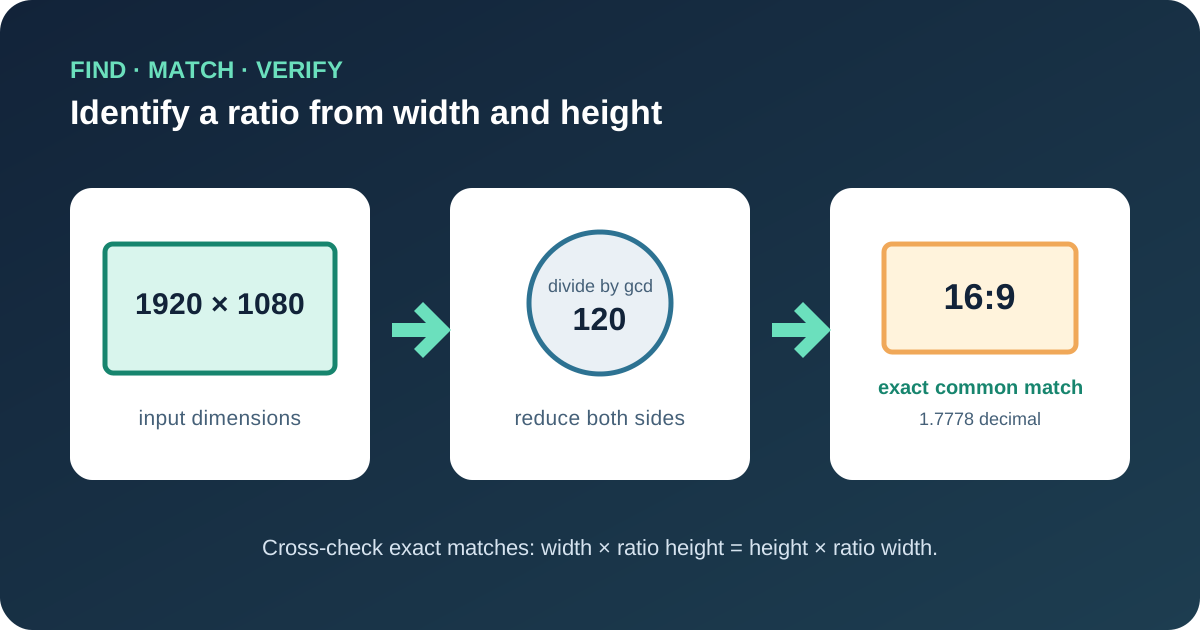
Find the exact ratio from pixel dimensions
Let W be width and H be height. For whole-number dimensions, calculate g = gcd(W, H). The exact reduced ratio is W ÷ g : H ÷ g. With 1920 × 1080, gcd(1920, 1080) = 120. Dividing both dimensions by 120 gives 16:9.
Exact identification
W = 1920 and H = 1080
g = gcd(1920, 1080) = 120
1920 ÷ 120 = 16
1080 ÷ 120 = 9
Exact ratio = 16:9
The decimal value is W ÷ H. Here, 1920 ÷ 1080 = 1.777777…, displayed as 1.7778 when rounded to four decimal places. The colon form preserves the exact integer relationship; the decimal form makes comparison easier.
Separate an exact ratio from the nearest common ratio
A ratio finder should report two different facts. The simplified pair identifies the dimensions exactly. A common-ratio match is a label used for comparison. If W × B equals H × A, the dimensions exactly match A:B. If the products differ, A:B is only a nearby shape.
For 1366 × 768 compared with 16:9, calculate 1366 × 9 = 12,294 and 768 × 16 = 12,288. The products differ by 6, so 1366 × 768 is close to 16:9 but is not exact. Its simplified ratio is 683:384, and its decimal value is about 1.7786.
For 2520 × 1080 compared with 21:9, both cross-products equal 22,680: 2520 × 9 = 22,680 and 1080 × 21 = 22,680. The dimensions simplify to 7:3, which is mathematically equivalent to 21:9. Both labels describe the same exact proportion.
Three-step ratio verification card
- 1Input
Enter width, height, and an optional DPI for a physical-size check.
- 2Calculate
Reduce W:H with the greatest common divisor and compare decimal shapes.
- 3Result
Read the exact ratio, common match, and print dimensions in inches.
Common ratio identification table
Decimal 1.0000
Example: 1080 × 1080
Decimal 1.3333…
Example: 1600 × 1200
Decimal 1.5000
Example: 3000 × 2000
Decimal 1.7777…
Example: 1920 × 1080
Decimal 2.3333…
Example: 2520 × 1080
Decimal 0.5625
Example: 1080 × 1920
The table uses exact arithmetic examples. A decimal displayed with an ellipsis repeats indefinitely. Matching by a rounded decimal alone can hide a small difference, so use cross multiplication to confirm an exact label.
Use DPI after the ratio is identified
DPI does not identify image shape. It converts stored pixels to physical inches. Print width = pixel width ÷ DPI, and print height = pixel height ÷ DPI. A 1920 × 1080 image at 300 DPI measures 1920 ÷ 300 = 6.4 inches by 1080 ÷ 300 = 3.6 inches.
The 16:9 ratio remains unchanged because both axes are divided by the same DPI. At 240 DPI, the same pixels measure 8 × 4.5 inches. The physical size changes, while the pixel pair and aspect ratio stay fixed.
Keep the questions separate
Ratio identity: reduce W:H.
Common shape: compare W ÷ H with known proportions.
Exact match: verify W × B = H × A.
Print size: divide both pixel dimensions by DPI.
Worked finder examples
| Dimensions | gcd | Exact ratio | Common identity |
|---|---|---|---|
| 1920 × 1080 | 120 | 16:9 | Exact 16:9 |
| 1280 × 720 | 80 | 16:9 | Exact 16:9 |
| 1080 × 1080 | 1080 | 1:1 | Exact 1:1 |
| 1600 × 1200 | 400 | 4:3 | Exact 4:3 |
| 1366 × 768 | 2 | 683:384 | Near 16:9 |
| 2520 × 1080 | 360 | 7:3 | Exact 21:9 equivalent |
For every exact label in the table, cross multiplication produces equal products. The 1366 × 768 row is deliberately labeled near 16:9 because its products differ. This prevents a familiar display name from replacing the exact reduced ratio.
Aspect ratio finder questions
How do I find an aspect ratio from width and height?
Find the greatest common divisor of the two whole-number dimensions, then divide both by it. The resulting pair is the exact simplified ratio.
Is 1280 × 720 a 16:9 aspect ratio?
Yes. The greatest common divisor is 80, and 1280 ÷ 80 : 720 ÷ 80 equals 16:9.
Why does the nearest common ratio differ from the simplified ratio?
The simplified ratio is exact. The nearest common ratio is a comparison label. They differ when the dimensions are close to, but do not exactly match, a familiar proportion.
Does DPI affect the aspect ratio?
No. DPI converts pixels to physical inches. Applying the same DPI to width and height preserves the ratio.