64:27 vs 21:9 Calculator
They are not mathematically equal. 64:27 is 2.370370:1; strict 21:9 reduces to 7:3, or 2.333333:1. At the same height, 64:27 is 1.5873% wider. Enter a resolution to test which ratio it actually uses.
The one-unit difference hidden by the label
Reduce 21:9 by three and it becomes 7:3. Put both ratios over a denominator of 27: 7:3 becomes 63:27, while the ultrawide ratio remains 64:27. The entire distinction is one horizontal unit out of 63 relative to strict 21:9.
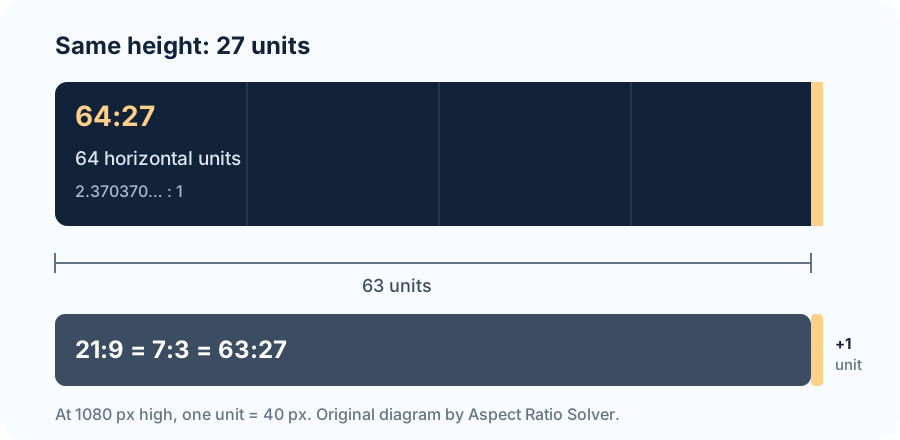
64:27 = 2.370370…
21:9 = 7:3 = 63:27 = 2.333333…
Relative width difference = (64 − 63) ÷ 63 = 1.587301…%
At a height of 1080 pixels, each denominator unit is 1080÷27 = 40 pixels. The 64:27 width is 64×40 = 2560. Strict 21:9 is 63×40 = 2520. That leaves a 40-pixel total difference, or 20 pixels on each side if a 2520×1080 picture is centered in a 2560×1080 frame.
What common ultrawide resolutions actually reduce to
The marketing family name does not determine the pixel ratio. The greatest common divisor of the two dimensions does. The table reduces each pair first, then compares its decimal value with both candidates.
| Resolution | Reduced ratio | Decimal | Exact 64:27? | Exact 21:9? | Drift from 64:27 |
|---|---|---|---|---|---|
| 2520 × 1080 | 7:3 | 2.333333 | No | Yes | −1.5625% |
| 2560 × 1080 | 64:27 | 2.370370 | Yes | No | 0% |
| 3440 × 1440 | 43:18 | 2.388889 | No | No | +0.7813% |
| 3840 × 1600 | 12:5 | 2.400000 | No | No | +1.2500% |
| 5120 × 2160 | 64:27 | 2.370370 | Yes | No | 0% |
Two familiar examples land exactly on 64:27: 2560×1080 reduces by 40, and 5120×2160 reduces by 80. By contrast, 3440×1440 reduces by 80 to 43:18. It sits about 0.7813% wider than 64:27 and about 2.3810% wider than strict 21:9. Calling all three “21:9” is useful retail shorthand, but it is not an exact-pixel test.
Three exactness tests
For 64:27, cross-multiply the measured dimensions: a frame is exact only when width×27 equals height×64. For strict 21:9, reduce first and test width×3 against height×7. These integer tests avoid rounding and work at any resolution.
For 2560×1080, both sides of the 64:27 test equal 69,120, so it passes exactly. The strict 21:9 test gives 7,680 on the width side and 7,560 on the height side, so it fails. For 3440×1440, neither cross-product pair matches, which proves that the panel is neither exact candidate despite the common label.
A third test uses divisibility. Every exact 64:27 integer pair is 64k×27k. Every exact strict-21:9 pair is 7k×3k. If a fixed height is divisible by 27, the 64:27 width is an integer; if it is divisible by 3, the strict-21:9 width is an integer. The calculator reports the reduced pair and both measured drifts so a near match cannot masquerade as equality.
Fit, pad, or crop at 1080 pixels high
A strict 2520×1080 frame placed inside 2560×1080 without scaling needs 40 horizontal pixels of padding: 20 on the left and 20 on the right. Filling the wider frame by uniform scaling instead requires a scale factor of 2560÷2520 = 64÷63, or about 1.015873. The scaled height becomes 1097.142857 pixels, so a centered fill would remove about 8.571 pixels from both the top and bottom before pixel rounding.
Going the other direction, fitting 2560×1080 content inside a strict 2520×1080 frame at full height cannot preserve both edges. A contain operation scales the width to 2520 and the height to 1063.125, leaving 16.875 vertical pixels total. A cover operation keeps the 1080 height and removes 40 horizontal pixels total. The correct choice depends on whether preserving the entire picture or filling the destination matters more.
These are geometry results, not display recommendations. Use the native pixel dimensions required by the panel or delivery system. Use the reduced ratio and cross-products when you need to verify what that resolution actually is.
Sources checked on 2026-11-10
Current manufacturer material was checked to confirm that products with 2560×1080 and 3440×1440 native resolutions are publicly labeled 21:9. Reference tables were checked for the 64:27 classification. All reductions, cross-products, pixel differences, fit/fill calculations, comparison values, calculator logic, and the SVG were independently produced for this page.
64:27 and 21:9 questions
Is 64:27 exactly the same as 21:9?
No. 64:27 is 2.370370:1. Strict 21:9 reduces to 7:3, or 2.333333:1.
Why is 2560×1080 called 21:9?
It belongs to the retail ultrawide family commonly labeled 21:9, but its pixels reduce exactly to 64:27.
Is 3440×1440 exactly 64:27?
No. It reduces to 43:18, or 2.388889:1.
How many pixels differ at 1080 high?
64:27 gives 2560×1080; strict 21:9 gives 2520×1080. The total width difference is 40 pixels.