4x5 Aspect Ratio
A 4x5 aspect ratio is the reduced portrait ratio 4:5, or 0.8:1. An integer-pixel frame is exact only when its width is divisible by 4, its height is divisible by 5, and 5W = 4H. Exact examples include 1080 × 1350, 1200 × 1500, and 2160 × 2700.
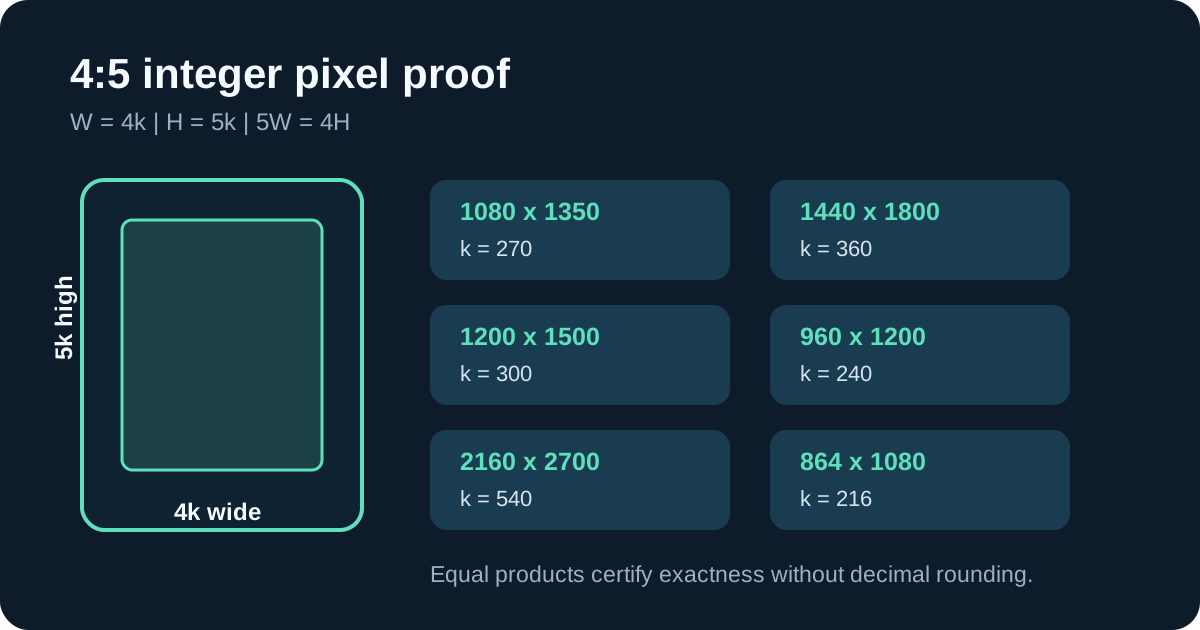
The four exactness tests say the same thing
Because 4 and 5 share no factor larger than one, 4:5 is already reduced. Every exact whole-pixel frame can be written as W = 4k and H = 5k, where k is a positive whole number.
Exact 4:5: W mod 4 = 0; H mod 5 = 0; 5W = 4H; and W/4 = H/5 = k.
The divisibility checks establish that both dimensions belong to the same integer grid. Cross multiplication then verifies the pair without relying on a rounded decimal.
| Pixels | 5W | 4H | Result |
|---|---|---|---|
| 1080 × 1350 | 5400 | 5400 | Exact |
| 1440 × 1800 | 7200 | 7200 | Exact |
| 1200 × 1500 | 6000 | 6000 | Exact |
| 960 × 1200 | 4800 | 4800 | Exact |
| 2160 × 2700 | 10800 | 10800 | Exact |
| 864 × 1080 | 4320 | 4320 | Exact |
Why a width of 1366 cannot produce an exact integer 4:5 frame
Hold the width at 1366 pixels and calculate the ideal height: 1366 × 5 / 4 = 1707.5 pixels. A stored raster cannot have half a pixel, so an integer result must be rounded and cannot remain exact.
The divisibility test reaches the same conclusion before division: 1366 mod 4 = 2. The width sits halfway between the neighboring multiples 1364 and 1368, producing the half-pixel height result.
Rounding down gives 1366 × 1707, where 5W = 6830 and 4H = 6828. Rounding up gives 1366 × 1708, where 5W = 6830 and 4H = 6832. Both miss equality by two product units. If width may change, use 1364 × 1705 or 1368 × 1710; both are exact because their shared k values are whole numbers.
Crop or pad a 1240 × 1860 portrait without stretching
A 1240 × 1860 source is 2:3, so it cannot fill a 4:5 frame without either removing pixels or adding canvas. Keeping the full 1240-pixel width sets the exact 4:5 height to 1240 × 5 / 4 = 1550 pixels. A centered crop therefore removes 310 pixels total: 155 from the top and 155 from the bottom.
That crop retains 1240 × 1550 = 1,922,000 of the original 1240 × 1860 = 2,306,400 pixels. The retained share is 1,922,000 / 2,306,400 = 83.333%; the removed share is 16.667%.
To keep every source pixel instead, hold the full 1860-pixel height and calculate the exact canvas width: 1860 × 4 / 5 = 1488 pixels. The 248 added columns split into 124 pixels on each side. The original image again occupies 83.333% of the final 1488 × 1860 canvas. Neither route stretches the source.
Largest exact 4:5 frame under a total pixel limit
An exact 4:5 frame contains (4k)(5k) = 20k² pixels. For a pixel ceiling P, the largest permitted whole-number scale factor is k = floor(√(P / 20)).
With a 12,000,000-pixel ceiling, k = floor(√(12,000,000 / 20)) = floor(√600,000) = 774. The resulting frame is 3096 × 3870 = 11,981,520 pixels. The next scale factor, k = 775, produces 3100 × 3875 = 12,012,500 pixels, so it crosses the ceiling.
When an export requires even width and height
Every exact 4:5 frame has W = 4k and H = 5k. Width is always even, but height is even only when k is even. For an export pipeline that requires both dimensions to be even, write k = 2m; the compatible grid becomes W = 8m and H = 10m.
For example, k = 271 gives 1084 × 1355. It is exact 4:5 because 5 × 1084 = 4 × 1355 = 5420, but its height is odd. Advancing to k = 272 gives 1088 × 1360, where both dimensions are even and 5 × 1088 = 4 × 1360 = 5440.
4:5 and 5:4 use the same numbers in opposite directions
Portrait 4:5 has width-to-height value 4/5 = 0.8. Rotate the frame and the landscape ratio becomes 5:4 = 1.25. The reciprocal check is 0.8 × 1.25 = 1.
This orientation change does not alter the proportion. A 1200 × 1500 portrait becomes a 1500 × 1200 landscape frame, and both use k = 300.
Which print sizes are exactly 4:5?
4 × 5 in, 8 × 10 in, and 16 × 20 in all reduce exactly to 4:5. Their units can be inches, centimeters, or another shared unit; equality depends on the ratio, not the unit name.
5 × 7 in is not 4:5: its portrait value is 5/7 = 0.714286. A4 is not 4:5: 210:297 reduces to 70:99, or 0.707071. Cropping or padding is required if either shape must enter an exact 4:5 frame without distortion.
Verify a 4:5 size before export
- 1Check divisibility
Confirm W mod 4 = 0 and H mod 5 = 0.
- 2Cross-multiply
Calculate 5W and 4H using the stored integer dimensions.
- 3Confirm one shared k
W/4 and H/5 must be the same whole number.
Use the aspect ratio calculator when one side is missing. Use these checks when the final pixel pair must be certified as exact.
4x5 aspect ratio questions
What is a 4x5 aspect ratio in pixels?
Any 4k × 5k pair is exact when k is a positive whole number. Examples include 1080 × 1350, 1200 × 1500, and 2160 × 2700.
How do I check whether dimensions are exactly 4:5?
Calculate 5 times the width and 4 times the height. Equal products prove exact 4:5. You can also verify that width divided by 4 and height divided by 5 produce the same whole-number k.
What is a 4K-size 4:5 frame?
The label 4K does not define one 4:5 pair. If a workflow fixes width at 2160 pixels, the exact paired height is 2700 pixels, giving 2160 × 2700 with k = 540.
Are 5x7 and A4 the same as 4x5?
No. 5:7 is about 0.714286 in portrait orientation, while A4 is 210:297 = 70:99, about 0.707071. Exact 4:5 is 0.8.
Sources
Common print-size groupings were checked against the George Mason University aspect-ratio print chart. The definition and print-resolution context were compared with ResizeFlow's 4:5 overview. The pixel equations, k table, 1366-pixel counterexample, crop-and-pad ledger, pixel-ceiling proof, even-dimension proof, cross-products, reciprocal check, and non-4:5 comparisons were recalculated for this page from the dimensions printed beside them.