2.39:1 Aspect Ratio Calculator
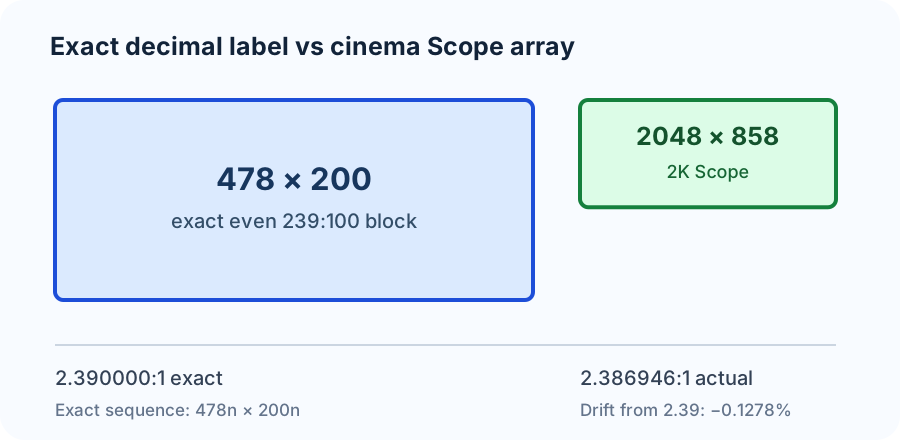
The decimal label 2.39:1 reduces exactly to 239:100. Exact integer sizes are 239k × 100k; exact sizes with two even edges are 478n × 200n. Cinema Scope arrays are close practical standards, not exact 239:100 multiples.
Why 2.39 becomes 239:100
Write 2.39 as 239 hundredths. Because 239 is prime and shares no factor with 100, the fraction is already reduced. Multiplying both sides by the same positive integer generates every exact integer resolution: 239k by 100k. The height is always even, but the width is even only when k is even, so a two-even-edge sequence advances in blocks of 478 by 200.
2.39 = 239 ÷ 100
Exact width = 239k
Exact height = 100k
Exact even pair = 478n × 200n
At a fixed width of 1920, the ideal height is 803.347280 pixels. The nearest even height is 804, producing 2.388060:1 and a drift of −0.0812%. Width 1920 cannot be exact because 1920 is not divisible by 239. The nearest exact even width below is 1912, from 478×4; the next one is 2390, from 478×5.
Exact, even, and cinema Scope sizes
This table keeps three ideas separate: exact 239:100 multiples, fixed-width even approximations, and standardized Scope picture arrays. Drift compares each actual width-to-height value with 2.39. A zero proves exactness; a small nonzero result records the geometry instead of hiding it behind the label.
| Case | Resolution | Actual ratio | Exact 239:100? | Both even? | Drift |
|---|---|---|---|---|---|
| Exact below 1920 | 1912 × 800 | 2.390000 | Yes | Yes | 0% |
| Fixed 1920 width | 1920 × 804 | 2.388060 | No | Yes | −0.0812% |
| 2K Scope | 2048 × 858 | 2.386946 | No | Yes | −0.1278% |
| Exact 2.39 sample | 2390 × 1000 | 2.390000 | Yes | Yes | 0% |
| Fixed 3840 width | 3840 × 1606 | 2.391034 | No | Yes | +0.0432% |
| 4K Scope | 4096 × 1716 | 2.386946 | No | Yes | −0.1278% |
The 4K Scope array doubles both edges of the 2K Scope array, so both share the same actual ratio and percentage drift. Doubling a near-match preserves its shape; it does not turn it into the exact fraction 239:100. This distinction matters when a custom canvas must pass an exact ratio test.
Fixed-width rounding test
For 1920 pixels, the ideal height is 1920×100÷239, or 803.347280. Whole-pixel rounding gives 803; 1920÷803 is 2.391034, a +0.0432% drift. Even-pixel rounding gives 804 and a −0.0812% drift. The whole result is closer to the label, while the even result satisfies a common encoder constraint.
At width 3840, the ideal height is 1606.694561. The nearest whole height is 1607; the nearest even height is 1606. The even choice now produces +0.0432% drift. This reversal shows why a rule such as “always round up” or “always use the lower even number” is unreliable. The correct candidate depends on the fixed edge and the delivery constraint.
The exactness test is simpler than the rounding test. For a fixed width, divide by 239. A whole quotient produces an exact integer height of 100 times that quotient. For two even edges, the quotient must also be even. If the quotient is fractional, any integer opposite edge is an approximation and should carry a measured drift.
Why 2048×858 is labeled 2.39:1
DCI material and ARRI delivery guidance identify 2048×858 as 2K Scope and 4096×1716 as 4K Scope. Dividing 2048 by 858 gives approximately 2.386946, which rounds to 2.39 at two decimal places. The label names the delivery format; it does not claim that the pixel pair reduces to 239:100.
The error is small but auditable. Against exact 2.39, the Scope arrays are about 0.1278% narrower relative to height. At height 858, an exact 2.39 width would be 2050.62 pixels, which cannot be represented as a whole pixel and would exceed the 2048-pixel Scope width. The standardized array therefore remains the correct choice when the required deliverable is DCI Scope.
Use exact 239:100 multiples for custom geometry that explicitly requires exact 2.39. Use the named 2048×858 or 4096×1716 arrays when a cinema workflow specifies those Scope pixel dimensions. This calculator measures dimensions and drift; it does not replace a distributor's delivery specification.
Technical references checked on 2026-11-09
The current Digital Cinema Initiatives specification page was checked for the active specification context. The DCI Compliance Test Plan was checked for the 2048×858 2.39 reticle. ARRI's conforming guidance was checked for 2K Scope at 2048×858 and 4K Scope at 4096×1716. All reduction proofs, boundary tests, drift values, calculator behavior, table entries, and the SVG were produced for this page.
2.39:1 resolution questions
What is the exact fraction for 2.39:1?
It is 239:100. Exact integer dimensions are 239k×100k.
Is 2048×858 exactly 2.39:1?
No. It is approximately 2.386946:1, but it is the 2K Scope pixel array identified by DCI material.
What is the 4K Scope resolution?
ARRI's conforming guidance lists 4096×1716 for 4K DCI Scope.
How do I make both edges even and exactly 2.39?
Use 478n×200n for any positive integer n, such as 1912×800 or 2390×1000.