1.85:1 Aspect Ratio Calculator
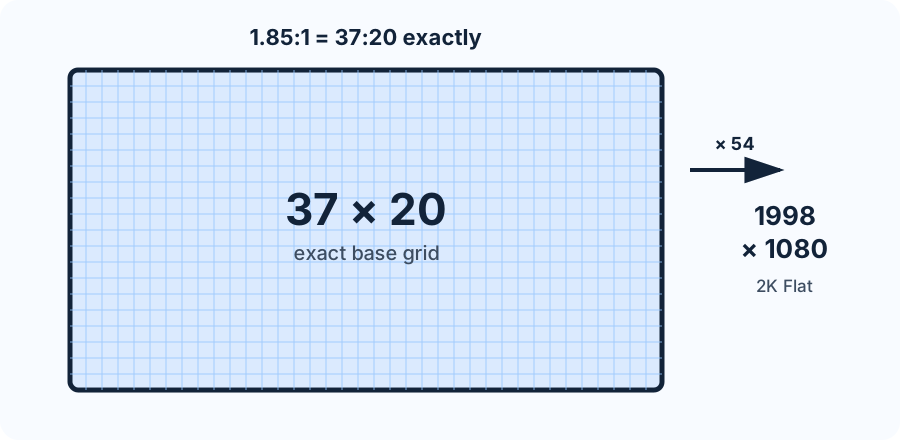
The decimal label 1.85:1 is the exact fraction 37:20. Every exact integer size is 37k × 20k; every exact even-pixel size uses an even k and is therefore 74n × 40n.
Why 1.85 becomes 37:20
Write 1.85 as 185 hundredths, then reduce 185:100 by their greatest common divisor, 5. The result is 37:20. That reduction matters because it reveals every exact pixel pair: multiply 37 and 20 by the same positive integer. For example, k=50 gives 1850×1000, k=54 gives 1998×1080, and k=108 gives 3996×2160.
1.85 = 185 ÷ 100 = 37 ÷ 20
Exact width = 37k
Exact height = 20k
Exact even pair = 74n × 40n
Height is already even for every integer k because 20k is even. Width, 37k, is even only when k is even. So an exact pair with two even edges advances in blocks of 74×40. This is stricter than simply rounding a calculated height to the nearest even number: rounding produces a practical approximation, while the multiplier test proves exactness.
Exact and practical 1.85:1 resolutions
The table separates exact 37:20 sizes from common fixed-width approximations. “Drift” compares the actual width÷height value with 1.85. A zero means the pixel pair is mathematically exact; a small nonzero value means one edge was rounded.
| Use case | Resolution | Actual ratio | Exact 37:20? | Both even? | Drift |
|---|---|---|---|---|---|
| Small exact test | 740 × 400 | 1.850000 | Yes | Yes | 0% |
| Exact below 1920 | 1850 × 1000 | 1.850000 | Yes | Yes | 0% |
| Fixed 1920 width | 1920 × 1038 | 1.849711 | No | Yes | −0.0156% |
| 2K Flat | 1998 × 1080 | 1.850000 | Yes | Yes | 0% |
| Fixed 3840 width | 3840 × 2076 | 1.849711 | No | Yes | −0.0156% |
| 4K Flat | 3996 × 2160 | 1.850000 | Yes | Yes | 0% |
At width 1920, the ideal height is 1037.837838 pixels. Rounding to the nearest even height gives 1038, only 0.162162 pixel above the ideal. Doubling both edges to 3840×2076 preserves the same rounded ratio and the same percentage drift. It does not make the pair exact; it only scales the approximation.
Boundary test around a 1920-pixel width
An exact pair cannot keep width 1920 because 1920 is not divisible by 37. The nearest exact even pair below it uses n=25: 74×25=1850 and 40×25=1000. The next exact even pair uses n=26: 1924×1040. The upper result is just 4 pixels wider than the requested edge, while the lower result is 70 pixels narrower.
If the width must remain exactly 1920, choose between a 1038-pixel even height and a 1037-pixel whole height. The 1038 result has an actual ratio of 1.849711, while 1920÷1037 is approximately 1.851495. Their absolute percentage drifts are about 0.0156% and 0.0808%, respectively, so the even result is also the closer result in this case.
This boundary test avoids a misleading claim that any width can produce an exact 1.85 frame. Exactness depends on divisibility. For width-led work, divide the width by 37; a whole quotient proves an exact integer height. For an exact pair with both edges even, that quotient must also be even.
Decimal label, cinema container, and rounding error
The label 1.85:1 is not an endless decimal approximation. It is a terminating decimal and therefore maps exactly to 37:20. The rounding problem begins only when a requested edge is not compatible with that reduced fraction.
The digital-cinema examples confirm the multiplier rule. The 2K Flat image 1998×1080 reduces by 54 to 37:20. The 4K Flat image 3996×2160 reduces by 108 to the same fraction. Both are exact and both use even multipliers. A full 2048×1080 container is wider, about 1.8963:1, so “2K” alone does not identify the Flat picture area.
For delivery, distinguish the requested canvas from the active image. If a system requires a fixed container, an exact 1.85 image may need symmetric padding inside it. If a platform accepts custom dimensions, an exact pair can be used directly. This calculator reports geometry and drift; it does not assert a codec, container, frame rate, or distributor requirement.
Technical references checked on 2026-11-08
The current Digital Cinema Initiatives system specification was checked for 2K and 4K container dimensions. SMPTE ST 429-2 was checked for the Flat pixel arrays: 1998×1080 at 2K and 3996×2160 at 4K. SMPTE ST 430-16 was checked for the 1.85 screen-aspect label. The reduction proof, boundary calculations, drift comparison, calculator, table, and SVG on this page were produced for this page.
1.85:1 resolution questions
What is the exact fraction for 1.85:1?
It is 37:20. Multiply both numbers by the same integer to generate exact pixel dimensions.
Is 1920×1038 exactly 1.85:1?
No. It is approximately 1.849711:1, a drift of about −0.0156%. It is a close even-pixel approximation.
What are the standard Flat cinema pixel arrays?
SMPTE ST 429-2 lists 1998×1080 for 2K Flat and 3996×2160 for 4K Flat.
How do I generate an exact even-pixel size?
Multiply 74×40 by any positive integer. Examples include 1850×1000, 1998×1080, and 3996×2160.