1:1 Aspect Ratio
A 1:1 aspect ratio is a square: width equals height. Any positive whole-pixel size W × W is exact, including 512 × 512, 1080 × 1080, and 2000 × 2000. To turn a W × H rectangle into a centered square, keep the short side and remove—or pad—the difference on the long side.
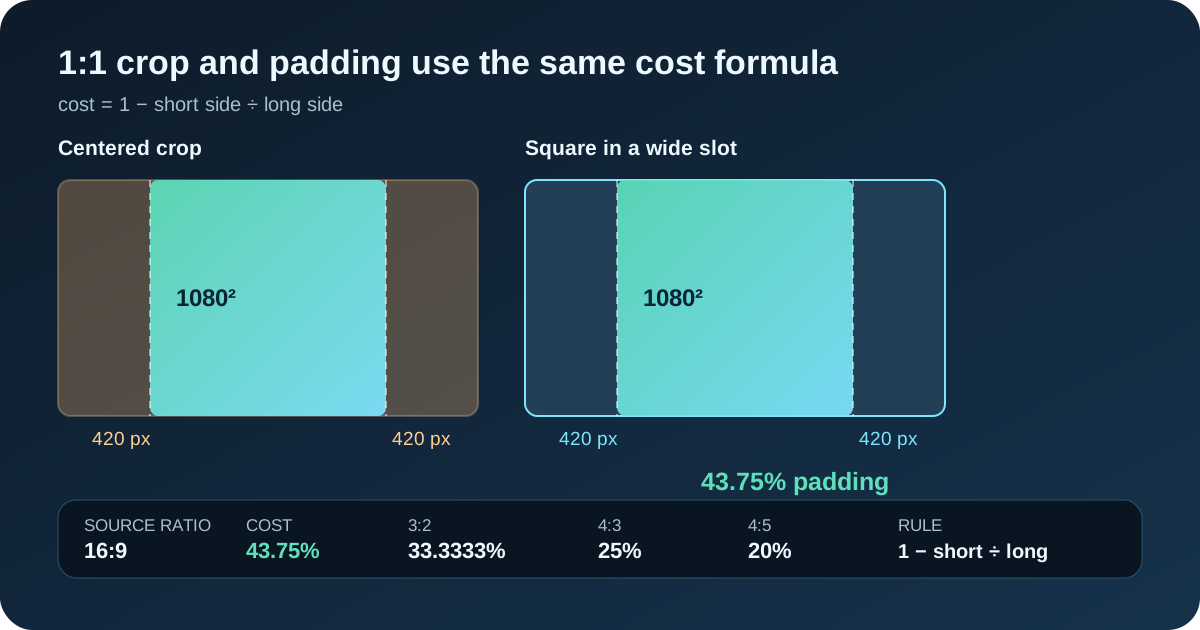
How much does a rectangle lose when cropped to 1:1?
The square side equals the rectangle’s short side. The share removed from the long dimension is 1 − short side ÷ long side. If the square is instead placed inside the original rectangular slot, the blank span along the long dimension has exactly the same size. Crop and padding therefore have equal percentage cost under this normalization.
For 1920 × 1080, the square is 1080 × 1080. The total horizontal crop is 1920 − 1080 = 840 pixels, so the crop share is 840 ÷ 1920 = 43.75%. A centered crop removes 420 pixels from each side.
Verify a 1:1 conversion in three steps
- 1Input the source
Use its final width and height, such as 1920 × 1080.
- 2Keep the short side
min(1920, 1080) = 1080, so the exact square is 1080 × 1080.
- 3Calculate the cost
1 − 1080 ÷ 1920 = 0.4375, or 43.75% of the long dimension.
Centered 1920 × 1080 → 1080 × 1080
Long-side difference = 840 px
Per-side crop = 840 ÷ 2 = 420 px
Crop share = 840 ÷ 1920 × 100
Padding share = 840 ÷ 1920 × 100
Both operations cost 43.75% of the normalized long dimension.
Square crop and padding cost by source ratio
The percentage depends only on the source ratio, not its pixel resolution. A rotated ratio has the same cost because its short and long sides simply exchange positions.
| Source or slot | Square | Total difference | Crop cost | Padding cost |
|---|---|---|---|---|
| 1920 × 1080 (16:9) | 1080 × 1080 | 840 px | 43.75% | 43.75% |
| 1620 × 1080 (3:2) | 1080 × 1080 | 540 px | 33.3333% | 33.3333% |
| 1440 × 1080 (4:3) | 1080 × 1080 | 360 px | 25% | 25% |
| 2560 × 1080 (21:9) | 1080 × 1080 | 1480 px | 57.8125% | 57.8125% |
| 2160 × 1080 (2:1) | 1080 × 1080 | 1080 px | 50% | 50% |
| 1080 × 1350 (4:5) | 1080 × 1080 | 270 px | 20% | 20% |
| 1080 × 1620 (2:3) | 1080 × 1080 | 540 px | 33.3333% | 33.3333% |
| 1080 × 1920 (9:16) | 1080 × 1080 | 840 px | 43.75% | 43.75% |
A 1:1 frame is unchanged by a 90-degree rotation. Unlike 16:9 and 9:16, it has no separate landscape or portrait counterpart.
How do you calculate square pixel dimensions?
With one known side, copy that value to the missing side: H = W or W = H. There is no divisibility condition because every positive integer can be used for both dimensions.
Use the main aspect ratio calculator when you need to solve a missing side before making the crop. For a fixed rectangular source, the largest square without padding always uses the shorter original side.
Common square dimension labels
| Label | Square dimensions |
|---|---|
| Social image | 1080 × 1080 px |
| Avatar | 400 × 400, 512 × 512, or 1024 × 1024 px |
| Album cover | 1400 × 1400 or 3000 × 3000 px |
| Product image | 1600 × 1600 px |
| App icon canvas | 512 × 512 or 1024 × 1024 px |
| 1-inch square | 300 × 300 px at 300 DPI; 600 × 600 px at 600 DPI |
How much of a common print is lost or left blank?
The same formula works for paper and photo dimensions. These values measure the part of the long dimension outside the largest inscribed square, or the equivalent blank span when the full sheet is centered inside a square.
| Format | Dimensions | 1 − short ÷ long | Cost |
|---|---|---|---|
| Photo | 4 × 6 in | 1 − 4 ÷ 6 | 33.3333% |
| Photo | 5 × 7 in | 1 − 5 ÷ 7 | 28.5714% |
| Photo | 8 × 10 in | 1 − 8 ÷ 10 | 20% |
| US Letter | 8.5 × 11 in | 1 − 8.5 ÷ 11 | 22.7273% |
| A4 | 210 × 297 mm | 1 − 210 ÷ 297 | 29.2929% |
| Photo | 12 × 18 in | 1 − 12 ÷ 18 | 33.3333% |
The unit cancels in every division, so inches and millimetres use the same calculation. At 300 pixels per inch, a 4-inch square needs 4 × 300 = 1200 pixels per side; DPI changes pixel density, not the 1:1 proportion.
What changes when a square becomes a circle or uses its diagonal?
A circle inscribed in a square of side s has area π(s ÷ 2)², while the square has area s². Their ratio is π ÷ 4 = 78.5398%, so the four corner regions together occupy 21.4602% of the square. A circular mask keeps the center and discards those corners.
The diagonal of a square is s√2. For a 1000 × 1000 square, the diagonal is 1000√2 = 1414.2136 pixels. Because √2 is irrational, this diagonal is not an exact whole-pixel length even though both sides are whole pixels.
1:1 aspect ratio questions
What size is a 1:1 aspect ratio?
Any square size: the width and height are equal. Examples include 512 × 512, 1080 × 1080, and 2000 × 2000 pixels.
How do I crop 1920 × 1080 to 1:1?
Keep the 1080-pixel height and crop the width to 1080 pixels. A centered crop removes 840 pixels total, or 420 pixels from each side.
Is 1:1 the same in portrait and landscape?
Yes. Rotating a square exchanges two equal sides, so its dimensions and ratio remain identical.
How much square area remains inside a circular crop?
An inscribed circle occupies π ÷ 4 of its square, or about 78.5398%. The four discarded corners total about 21.4602%.
Sources and calculation scope
The ratio, crop, padding, paper, circle-area, and diagonal results on this page are direct calculations from the dimensions and formulas printed beside them. Each percentage uses (1 − short side ÷ long side) × 100; the circle result uses π ÷ 4; and the diagonal uses the Pythagorean result s√2.
General context for square image ratios was checked against the image aspect-ratio overview. No traffic, popularity, ranking, or performance values are asserted on this page.